Research
political behaviourgender and politicsmigration and diaspora politicsauthoritarian politicstransnational repressionsocial movementspanel surveyssurvey experimentsmixed methods
How do authoritarian states continue to shape the political lives of people who have left them — and does that process work differently on women and men? I study this through the post-2022 Russian emigration, one of the largest politically induced migrations in recent European history, and treat it as a case of something more general: how states govern the diasporas that fled them.
Most of my quantitative work draws on OutRush, a five-wave panel survey of Russian emigrants in more than 100 countries, where I am a co-investigator. I read it against in-depth interviews, because the mechanisms that make repression effective are often not the ones a survey was designed to measure.
Gender and political participation
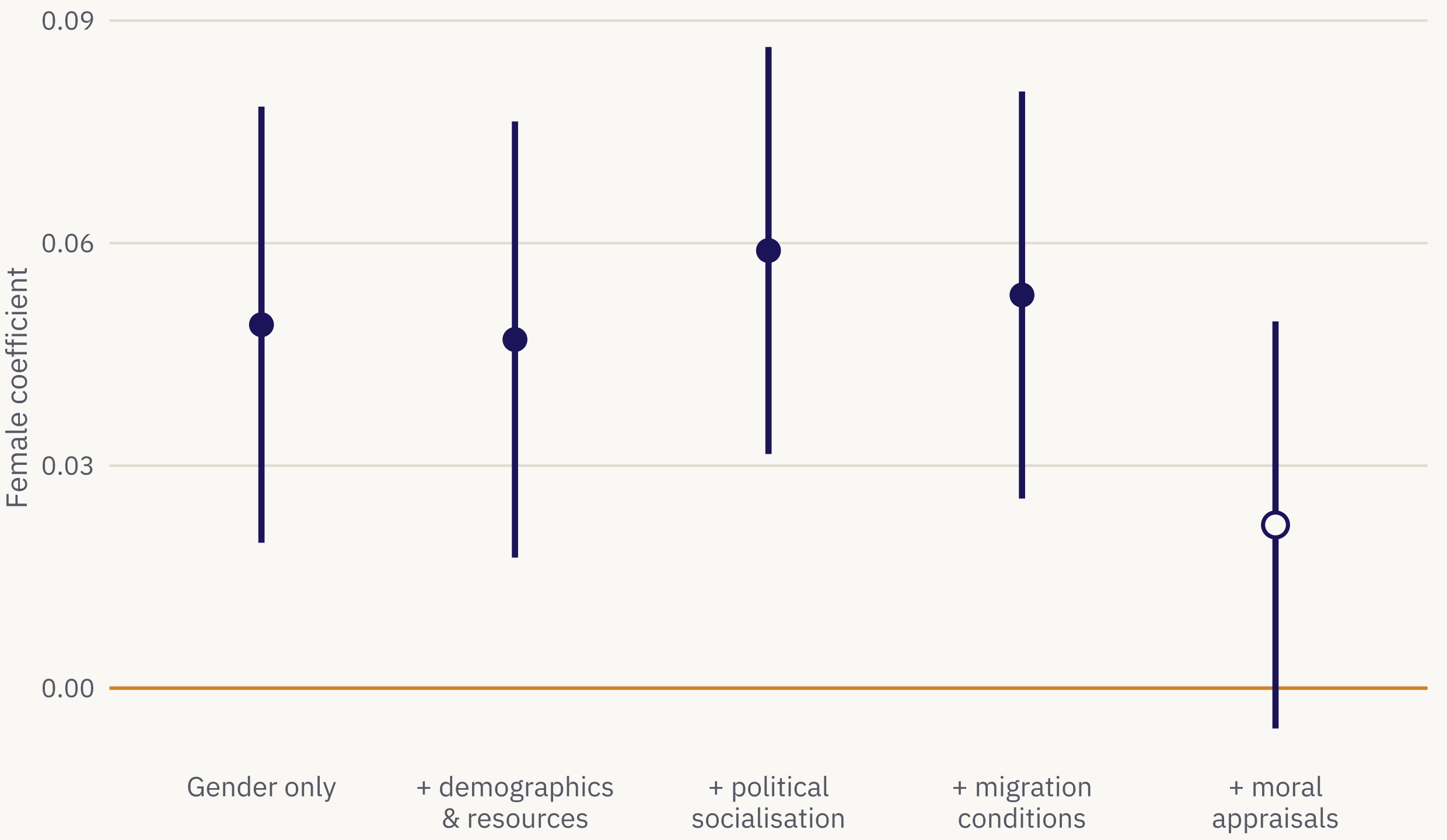
Women mobilise more in exile
OutRush panel, N = 1,734 · weighted OLS and Blinder–Oaxaca decomposition · 68 matched in-depth interviews across six countries
In the OutRush panel, women take part in political action at higher rates than men. This is the opposite of the pattern found in most democracies, and the usual explanations do not account for it: it is not education, income, free time, or prior activist experience.
What does account for it is moral responsibility — the sense of being answerable for a war waged in one’s name. Women report this more often, and it translates into action more consistently. Put simply: when people leave a country at war, what moves them to act is less what they have than what they feel answerable for.
Moral Responsibility and the Reverse Gender Gap (under review) · Men’s Words, Women’s Work
Emotion, social movements, and feminist organising
Emotion as political infrastructure
56 in-depth interviews with Feminist Anti-War Resistance activists in 25 countries · thematic and focused coding
I work in a feminist research tradition that treats emotion as organisational infrastructure rather than individual psychology, and that takes political work done in private, low-visibility settings as seriously as public protest.
Drawing on interviews with activists of the Feminist Anti-War Resistance, I show how exiled movements build what I call affective infrastructure: the routines of care, recognition, and emotional maintenance that keep a movement alive when its public forms become dangerous or unavailable. This is the labour that sustains mobilisation between its visible moments — and it is disproportionately done by women, which is one reason standard measures of participation miss it.
Micromobilizing Emotion: How Feminist Anti-War Resistance Builds Affective Infrastructure in Exile · Communist and Post-Communist Studies, 2026
Authoritarian politics and transnational repression
Citizenship as leverage
Five-wave OutRush panel · Callaway–Sant’Anna difference-in-differences with staggered adoption · 579 in-depth interviews
Citizenship is usually studied as what membership provides. It is also what membership creates: a lasting dependency on the state for passports, documents, civil status, and the right to return — things no other actor can supply. Under authoritarianism that dependency becomes a tool of control, and it does not stop at the border.
With Emil Kamalov and Ivetta Sergeeva, I develop the concept of extraterritorial authoritarian citizenship and show that it produces latent leverage: the ability to impose costs without using it against anyone in particular. In the OutRush data, fear of the Russian state is close to universal while personal targeting is rare, and what people fear is open-ended bureaucratic reach rather than violence. That fear suppresses the most visible and attributable forms of participation — protest, posting under one’s own name — while leaving civic engagement untouched. Acquiring another citizenship lowers the fear itself, but does not make people act more boldly on the fear that remains.
Citizenship as Leverage: Authoritarian Control Beyond Borders (working paper) · presented at APSA and ECPR 2026
Current agenda
Gendering transnational repression
In progress · instrument design, panel analysis, and comparative extension beyond the Russian case
Research on transnational repression is largely built around one figure: the visible, publicly identifiable dissident. Its instruments measure what tends to happen to him — prosecution, foreign-agent designation, border interrogation, conscription. I am interested in what this misses, in two ways.
Some forms of repression are gendered by design. Authoritarian states use sexualised harassment, threats organised around family and reputation, and public campaigns that cast women’s activism as immoral. These are not incidental: they work by spreading misogyny and pushing women out of political life altogether, and they are rarely captured by instruments built to record arrests and prosecutions.
And the same forms may land differently. In the OutRush panel, women report fearing Russian repression more often than men. What does that do to their political behaviour — does it suppress it, redirect it into less visible forms, or leave it intact? Given that women and men already participate through different repertoires, identical pressure need not produce identical responses.
My current work asks whether women and men are reached by different repertoires of origin-state pressure, whether exposure produces different behavioural responses, and what a measurement instrument would look like if it were designed around gendered forms of transnational control rather than around the prosecution of public dissidents. I am extending this beyond the Russian case, to ask how origin-state leverage and host-country conditions together shape what political action remains available to women in authoritarian diasporas.
Toolkit
Data and methods
I use multi-wave panel models, difference-in-differences with staggered adoption, conjoint and survey experiments, and multilevel models across host countries. I also design and conduct qualitative fieldwork, and work on the methodology of surveying politically vulnerable and hard-to-reach populations: sampling without a frame, recruitment through closed networks, measuring sensitive behaviour, and contact procedures that minimise traceability for respondents who have reason to fear it.
Projects I draw on
- OutRush — five-wave panel survey of post-2022 Russian emigrants, 30,000+ observations in over 100 countries. Co-PIs: Emil Kamalov and Ivetta Sergeeva; I am a co-investigator.
- Building a Commons in Russia’s Anti-War Diaspora — around 600 semi-structured interviews across six countries. PI: Regina Smyth (Indiana University).
- Feminist Anti-War Resistance in Exile — in-depth interviews with activists of the feminist anti-war movement. PI: Regina Smyth (Indiana University); I am a co-investigator.